Where penalties apply
49 states have penalties for illegally passing a stopped school bus. Arizona is the outlier. At least 25 states authorize stop-arm cameras.
That single sentence is the honest summary of ten years of federal crash data. Everything below explains why — and what to teach your child so the risky part stops being risky.
From NHTSA’s School-Transportation-Related Traffic Crashes, 2013–2022, the federal government’s own ten-year count.
| Who died | 10-year total | Share |
|---|---|---|
| Occupants of other vehicles | 763 | 71% |
| Pedestrians (people on foot near the bus) | 169 | 16% |
| Occupants of school transportation vehicles | 111 | 10% |
| Other non-occupants | 39 | 4% |
| Total | 1,082 | 100% |
The area around a stopped bus where the driver simply cannot see a child.
NHTSA and state education departments define the danger zone as roughly ten feet on all four sides of the bus, extending to about thirty feet in front in some state materials. New Jersey’s Office of School Bus Safety states plainly that most school-bus-related incidents happen inside that ten-foot radius, where the driver has limited visibility.
A child is short. A bus is tall and long. There is a band of ground around it that is invisible from the driver’s seat, and a five-year-old fits inside it completely.
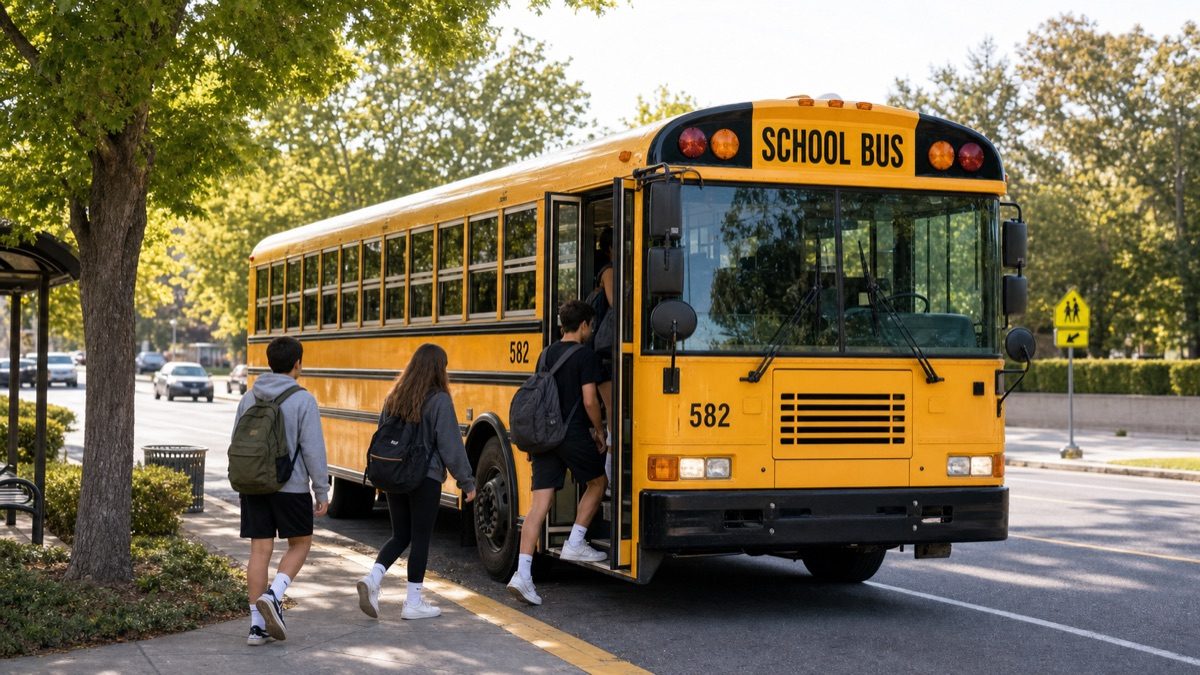
Walk your child through this at the actual stop before the first day. Reading it is not the same as doing it.
In every state, traffic in both directions must stop for a bus with red flashing lights and an extended stop arm. Divided-highway exceptions vary by state.
49 states have penalties for illegally passing a stopped school bus. Arizona is the outlier. At least 25 states authorize stop-arm cameras.
First-offense fines commonly run $150–$500. 15 states allow fines over $1,000 on a first conviction, 17 allow jail, 12 allow a license suspension of 30+ days, and 19 assess five or more license points.
Connecticut: $450 first offense; $500–$1,000 plus up to 30 days jail after that, and 4 points. Minnesota: a misdemeanor, up to 90 days and $1,000 — rising to a gross misdemeanor, one year and $3,000, in aggravated cases.
It is the question every parent asks, and the answer is genuinely more interesting than “nobody got around to it.”
School bus seats are tall, closely spaced, and padded with energy-absorbing seat backs — a padded compartment, like an egg carton. In a frontal crash a child moves forward a short distance into a cushioned seat back that absorbs the energy. No buckle required, which matters when you have 70 children and one adult.
It works well for frontal and rear impacts. That is a large part of why bus occupant deaths are so low.
Where it does less is side impacts and rollovers, where a child can be thrown out of the compartment entirely. That gap is the whole safety case for lap and shoulder belts: rollover was the impact mode in 31 of the 111 occupant deaths over the ten-year period.
Federal: FMVSS 222 requires compartmentalization on large school buses (over 10,000 lbs). Small school buses at or under 10,000 lbs must have lap or lap/shoulder belts, because they behave more like light vehicles in a crash. NHTSA has not mandated belts on large buses, while stating that lap/shoulder belts on all school buses are its recommended best practice.
State: roughly nine states have school bus seat belt requirements — Arkansas, California, Florida, Iowa, Louisiana, Nevada, New Jersey, New York and Texas — but the details differ sharply. Florida requires two-point lap belts. New York lets each school board decide, and does not require students to wear them. Texas applies its rule to buses bought from a set date forward.
Most parents never ask any of these. The answers change what you do on day one.
1. What are the walk-distance rules for my child’s grade, and is distance
measured straight-line or along the walking route?
2. Is there a hazardous-walking-route review, who conducts it, and how do I request
one in writing?
3. What is my child’s assigned stop, route number and scheduled time —
and what variance is considered normal?
4. What is the maximum ride time policy?
5. Is there a parent-facing bus tracking app, and how do I get access?
6. How am I notified when a route is cancelled or delayed, and how far ahead?
7. What is the post-trip inspection procedure that ensures no child is left asleep
on a bus?
8. Will a young child be released at the stop without an adult — and can I
require adult release in writing?
9. Are buses equipped with cameras, and how long is footage kept before it is
overwritten?
10. Do the buses have seat belts, and are students required to wear them?
11. Are drivers and aides background-checked, and what training do they get on
students with disabilities and on bullying?
12. Who is the transportation director, and what is the written complaint and
escalation path?
Sources. National Highway Traffic Safety Administration, Traffic Safety Facts: School-Transportation-Related Traffic Crashes, 2013–2022 Data (DOT HS 813 600, August 2024); NHTSA School Bus Safety program pages; New Jersey Department of Education Office of School Bus Safety; NASDPTS National Stop Arm Violation Survey (2025); Connecticut Office of Legislative Research reports 2025-R-0029 and 2024-R-0205; FMVSS 222. Figures are national and were current when this page was written. Seat belt requirements in particular change from session to session — verify your own state and district before relying on anything here. This page is general public information, not legal advice.